
Assess what is really happening
Evaluate current AI activity, business objectives, workflows, data readiness, workforce capacity, governance, risks, and organizational dependencies.
AI Adoption & Change Management
Alaryn helps leaders move from disconnected AI experimentation to measurable business value by aligning the workflows, data, governance, decision rights, workforce capabilities, and human judgment surrounding the technology.
Focused, time-bound advisory support—without creating a long-term consulting dependency.
An organization can achieve high AI usage while creating inconsistent decisions, duplicating work, exposing sensitive information, weakening accountability, or automating a process that should have been redesigned first.
Most AI-adoption problems are not caused by the technology itself. They emerge from the environment surrounding it.
Training alone cannot solve these conditions. Neither can a framework applied word for word.
Alaryn provides an independent assessment of the organizational conditions affecting AI adoption, identifies where AI can create meaningful value, and builds the operating model and prioritized roadmap required to move forward responsibly.
Evaluate current AI activity, business objectives, workflows, data readiness, workforce capacity, governance, risks, and organizational dependencies.
Clarify priority use cases, ownership, decision rights, human oversight, operating processes, governance, and the capabilities teams need to work differently.
Create a sequenced roadmap, adoption strategy, performance measures, feedback loops, and practical recommendations leaders can execute.
A useful AI strategy connects six elements. Weakness in any one of them can limit value or introduce unnecessary risk.
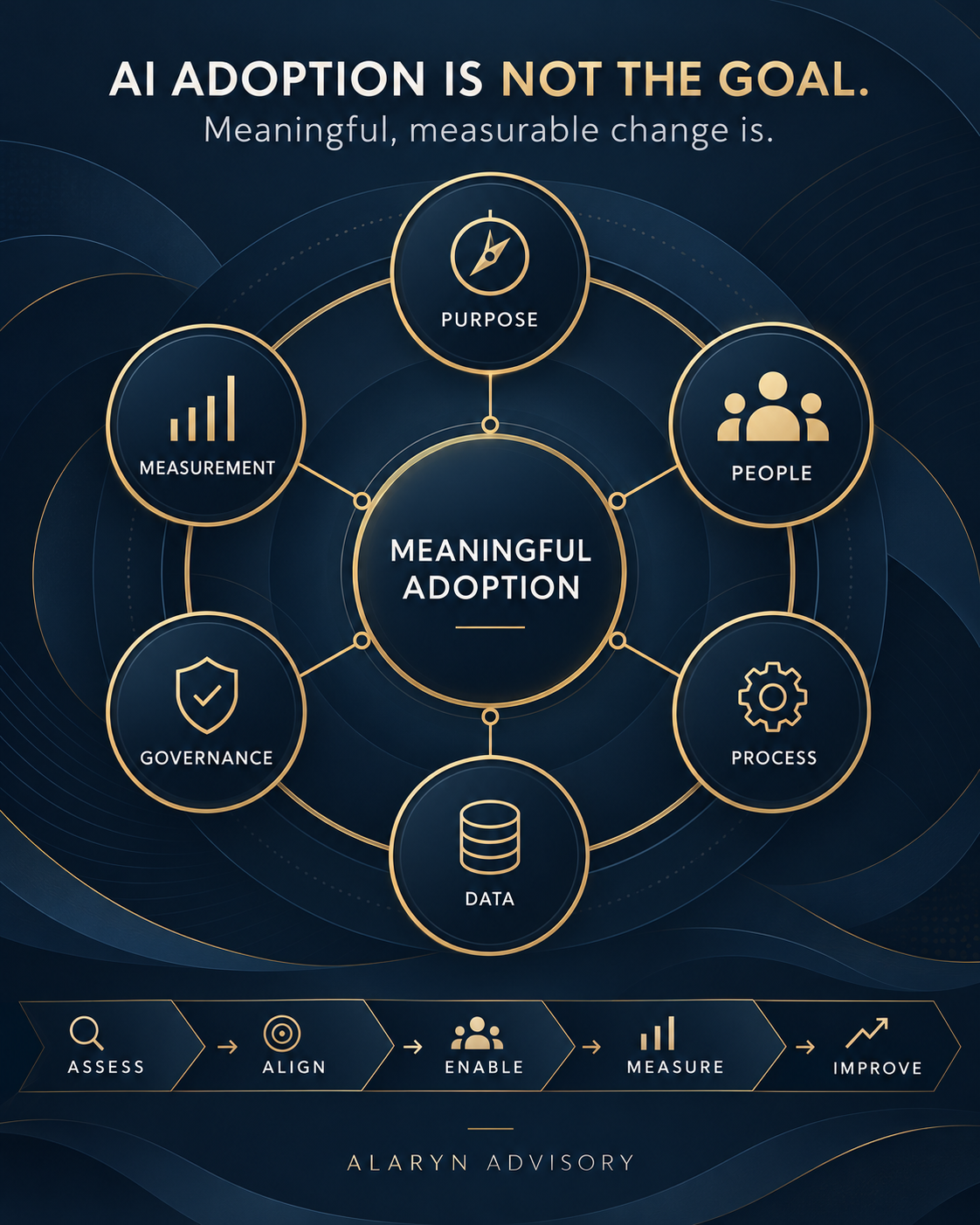
Depending on the organization’s needs, the engagement may produce:
The objective is not to create dependence on a consultant. It is to give leaders the clarity, structure, and capability to make informed decisions and execute responsibly.
Amanda Edwards brings more than two decades of transformation experience across healthcare, SaaS, product operations, enterprise technology, and regulated data environments. Her work includes AI-enabled workflow design, acceptable-use policy development, tool governance, privacy and compliance alignment, vendor evaluation, adoption measurement, workforce enablement, and cross-functional operating-model design.
She approaches AI as an operational and organizational transformation—not as a technology deployment alone.
Let’s identify where AI can create value, what could prevent it, and the practical path forward.